
Total Volatile Organic Compound
Total Volatile Organic Compound (TVOC) Measurement for LEED/Green Building Evaluation
Total Volatile Organic Compounds (TVOC) may be evaluated when building designers/managers are pursuing the Leadership in Energy and Environmental Design Green Building Rating System for New Construction (LEED-NC) EQ Credit 3.2. The latest LEED-NC guidance document specifies that the maximum allowed concentration of TVOC measured in a building (post construction, pre-occupancy) is 500 µg/m3; the guidance also mentions using the sampling/analytical methods in the US EPA Compendium of Methods for the Determination of Air Pollutants in Indoor Air. However, none of these sampling and analytical methods address TVOC in particular, and thus the existing methods must be modified. In addition, TVOC is not defined (in terms of boiling point range, etc.) in the latest LEED-NC guidance and therefore is left open for interpretation; historically, many definitions of “TVOC” exist in literature.
For TVOC measurement, the analytical technique used must always reference one compound for calibration purposes. All compounds detected are then assumed to have the same response factor as the calibration compound. For instance, handheld instruments are most often calibrated using isobutylene or methane, and laboratory-based methods may reference TVOC as hexane (C6), toluene, or some other chemical species.
In practice, indoor air quality practitioners may use several different techniques for evaluating TVOC in buildings. Each sampling & analytical method has its own benefits and drawbacks, cost implications, and applicability.
Handheld “Real-Time” Instruments
Handheld photoionization detectors (PIDs) and flame ionization detectors (FIDs) are common tools used for site investigation. PIDs contain a UV lamp of a particular energy (e.g. 10.6 eV or 11.7 eV); any chemical species with an ionization potential at or below this energy will be detected. FIDs require a fuel gas (hydrogen) to burn hydrocarbons in a small flame, ionizing the chemical species which are present; thus any chemical species with a C-H bond (hydrocarbons) will be detected (including lighter end C1-C3 hydrocarbons, which may not be considered part of a TVOC definition). This type of instrument is typically calibrated by running a “zero” (blank/clean air) and “span” (known concentration of calibration gas, isobutylene for PIDs and methane for FIDs) measurement—essentially a one point calibration forced through zero. While each of these instruments respond to a wide range of compounds and yield a “total” value, the detection limits of these instruments are typically in the range of 0.1-0.5 ppmV (as methane for FID, as isobutylene for PID), and therefore may not be suitable for the low-level TVOC assessment required for LEED. However, ultra-sensitive PIDs currently exist in the marketplace, with manufacturers claiming detection limits in the low ppbV range and accuracies within 20 percent. Costs to rent this type of equipment range from approximately $50-$100/day, plus any costs for associated equipment (calibration gases, dataloggers, etc.).
Charcoal Tubes
NIOSH/OSHA methods such as NIOSH 1500 or OSHA 07 use small coconut shell charcoal tubes and personal sampling pumps to sample for VOCs in air. Traditionally, these methods were written to address workplace exposure issues, and the reporting limits of these methods are typically in the ppmV (mg/m3) range. Air is drawn through the tubes with a pump at a known flow rate for a known amount of time, with the compounds of interest adsorbing on to the charcoal media. Back at the laboratory, the charcoal in the tubes is then chemically desorbed with a small volume (1-2 mL) of solvent such as carbon disulfide. A small microliter amount of that solvent extract is then injected into a gas chromatograph (GC), typically equipped with a flame ionization detector (FID). Since only a very small portion of the sample (approximately equivalent to 1/1000th of the volume of air sampled) is being analyzed, the sensitivity of the analysis is only moderate (although completely adequate for traditional workplace exposure monitoring). The laboratory analysis will determine the total mass of contaminants captured and report it as “TVOC as Toluene” (or other chemical species); concentration is calculated by dividing the mass by the total volume of air pulled through the tube. When using this technique to evaluate TVOC for LEED, it may be necessary to increase the sampling flow rate and/or sampling duration to lower the detection limit below 500 µg/m3. Costs for this type of analysis range from approximately $65-125 per sample.
Thermal Desorption Tubes
Methods such as EPA Method TO-17 (1999), EPA IP-1B (1990) and/or NIOSH 2549 (1996) use stainless steel thermal desorption tubes (packed with one or multiple sorbent materials) and a personal sampling pump to sample for VOCs in indoor/ambient air. In general, thermal desorption methods were written to detect low concentrations of VOCs in indoor/ambient air, with reporting limits typically in the low ppbV (µg/m3) range. Air is drawn through the tubes with a pump at a known flow rate for a known amount of time, with the compounds of interest adsorbing on to the sorbent media. The tube is then thermally desorbed and the entire amount of all compounds of interest is transferred to the GC column for analysis.
For this analysis, the GC is equipped with a mass spectrometer for the detector (GC/MS), allowing for qualitative and/or quantitative identification of all species present (based on retention time and matching of the sample spectrum against a NIST library). Since the entire sample may be consumed, the sensitivity of this analysis is 100-1000 times greater than the traditional (solvent desorption) charcoal tube approach. The laboratory analysis will determine the total mass of contaminants captured and report it as “TVOC as Toluene” (or other chemical species); concentration is calculated by dividing the mass by the total volume of air pulled through the tube. Costs for this type of analysis are in the range of $125-$250/sample.
Table 1 presents a summary of pros and cons for the solvent desorption (traditional charcoal tubes) and thermal desorption approaches.
Table 1. Solid Sorbent Sampling: Solvent Desorption vs. Thermal Desorption for TVOC
|
|
Solvent Desorption |
Thermal Desorption |
|
Analytical Methods |
|
|
|
Typical Sorbent Used |
|
|
|
Analytical Detector |
|
|
|
Concentration Range |
|
|
|
Amount Analyzed |
|
|
|
Advantages |
|
|
|
Disadvantages |
|
|
Passive Sorbent Samplers
Passive sampling technology has long been used to monitor workplace/indoor air exposures (both personal monitoring and area samples). A sorbent material is contained in some convenient form (e.g. clip on badge, tube with diffusive cap, etc.) and air passively enters the sampler without the use of a personal sampling pump. Compounds of interest are adsorbed onto the sorbent media, in the same manner as active sorbent sampling (either traditional charcoal tubes or thermal desorption tubes). Different types of passive samplers exist; some types utilize solvent desorption and some types utilize thermal desorption.
One main limiting factor for passive samplers is the uptake rates for various compounds of interest. Current technology such as the Radiello sampler allows for high diffusivity/effective flow rates, while also allowing for a sensitive GC/MS thermal desorption analysis.
Costs for passive sorbent samplers vary widely, depending on the analytical technique used (either solvent or thermal desorption).
Table 2 presents a summary of the pros and cons associated with passive sorbent sampling and active sorbent sampling (using a personal sampling pump).
Table 2. Solid Sorbent Sampling: Active Sampling vs. Passive Sampling
|
|
Active Sampling |
Passive Sampling |
|
Advantages |
|
|
|
Disadvantages |
|
|
Canisters
EPA Method TO-15 (and IP-1A) utilizes evacuated stainless steel canisters to collect whole air samples for VOC analysis. Canisters will be fully evacuated by the analytical laboratory so that when the canister valve is opened, air enters the canister without the use of a pump. A flow controller may be put inline to restrict the flow entering the canister so that the canister fills over a longer time period (i.e. four hours for LEED sampling). Since only an aliquot of the total volume collected is analyzed, re-analysis and/or dilutions are possible from the same sample canister. Similar to the thermal desorption techniques, the analysis is via GC/MS, allowing for qualitative and/or quantitative identification of target compounds. Costs for this type of analysis are in the range of $125-$250/sample.
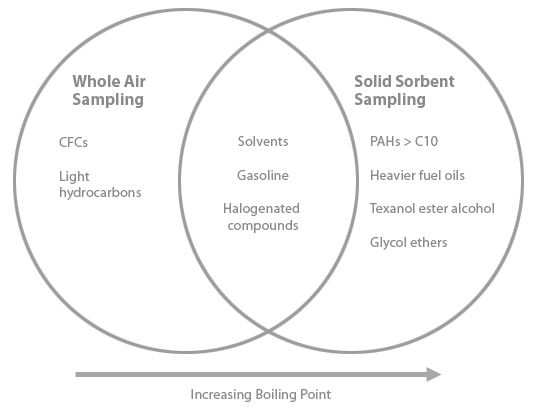
Figure 1 summarizes the types of compounds that will be detected by whole air sampling (i.e. canisters) and solid sorbent sampling, and which compounds may be detected via either technique.
Figure 1. Compounds Detected via Whole Air Sampling (Canisters) vs. Solid Sorbent Sampling
Summary
Many analytical choices exist for measurement of TVOC for LEED projects. Practitioners must make an educated choice, consulting with their laboratory personnel where applicable, to decide which TVOC method may be most appropriate for their project. When deciding which sampling/analytical method to use, consideration must be given to the sample analysis/equipment rental costs, time frame/turnaround time needed, the building owner’s interest in having detailed chemical indoor air quality information, as well as which building materials (e.g. paints, carpet glues, finishes, cabinetry, etc.) are used. Also, if qualitative information is desired about which specific compounds comprise the TVOC value (e.g. for troubleshooting purposes if a building continues to fail to meet the 500 µg/m3 criteria), a GC/MS technique (thermal desorption or canisters) must be used. Until TVOC is defined more specifically, and/or until specific analytical methods are given in the LEED documentation, practitioners will have a wide range of options available to meet this credit requirement.
There are no products listed under this category.